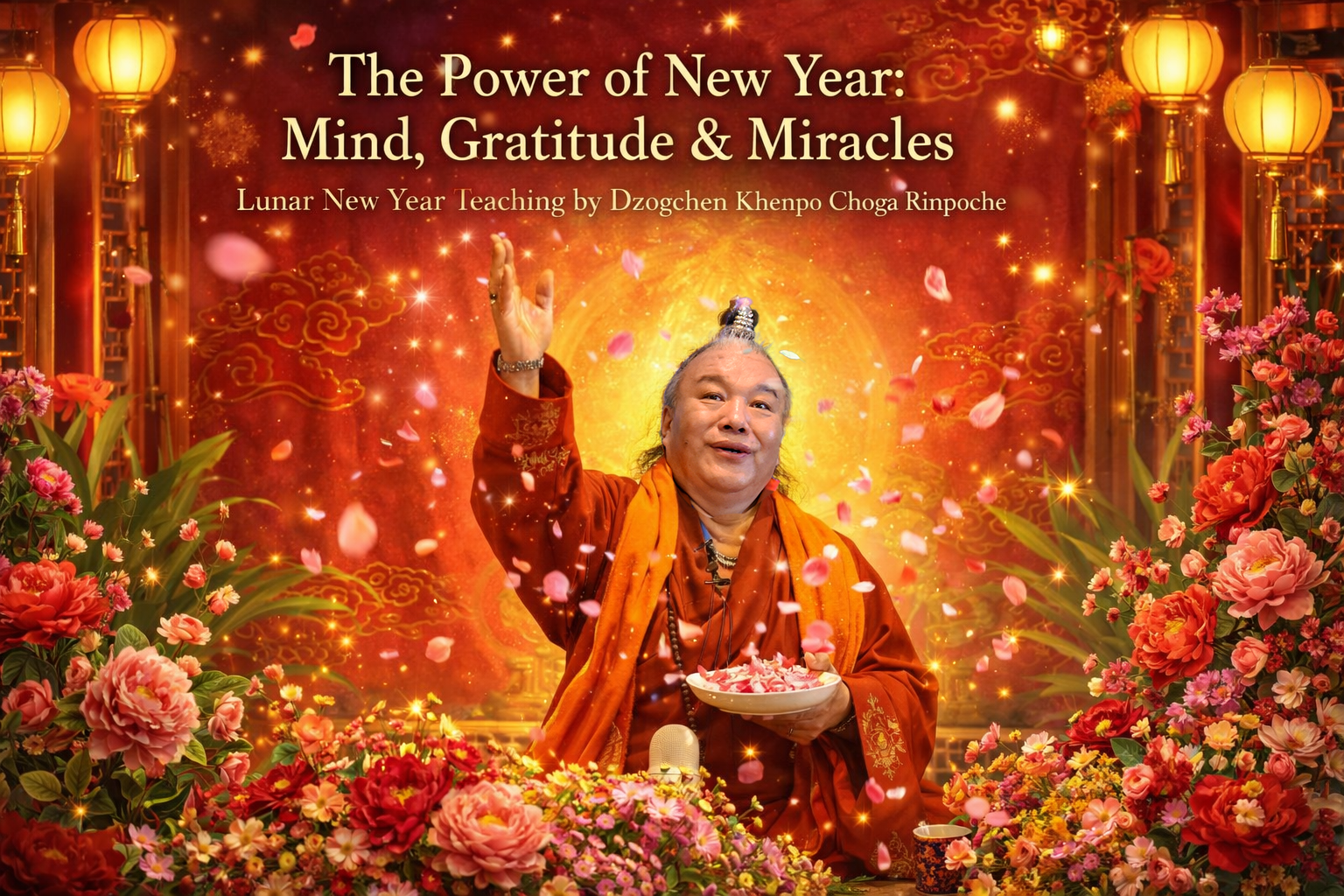
A Lunar New Year Teaching by Dzogchen Khenpo Choga Rinpoche
Today marks the Year of the Fire Horse—a year when the secret door of sacred Mount Kailash opens. Because of this auspiciousness, Tibetans travel from across the world to circumambulate the mountain thirteen times. In fact, it was in a Horse Year that the great Emperor Trisong Deutsen was born, the king who transformed Tibet into a Buddhist kingdom.
However, I want to talk to you about something even more sacred than Mount Kailash.
Your mind.
Why Mind Is More Valuable Than Anything
Right now, many people believe they have no mind—only brain. And now artificial intelligence is popular, which seems a little better than brain. But if this is what you believe, then you believe you have nothing valuable.
Buddhist understanding, however, is completely different. Mind is your present-moment awareness. This awareness creates karma, and karma creates all phenomena—including your body, your brain, and everything else.
Therefore, mind is the center of the universe. It is the creator of the universe, the ultimate decision-maker, chooser, and knower. Mind is unsurpassable and incomparable.
So every time you value only external things, you actually degrade the value of your own mind. Yes, money is important. Your house is important. But how about your mind?
The Extraordinary Power of Concept
New Year is a concept. Chinese New Year is today, while Tibetan New Year is tomorrow. Both are New Year—and both are not New Year. It depends entirely on how you think.
Many people say “this is just a concept” as if concepts are weak. On the contrary, concept is extraordinarily powerful.
How Concept Shapes Reality
For example, if you regard your mother as mother, she helps you—there is healing power. But if you regard mother as enemy, then you have an enemy and no longer have a mother.
Similarly, most people carry the concept that they are ugly. That single concept is powerful enough to steal happiness for an entire lifetime. In addition, some believe they are unfortunate—and consequently, that belief becomes an excuse for everything.
In other words, concept is everything.
Why New Year Is a Good Concept
New Year represents a chance to reset and a fresh beginning. Even if you make mistakes, it’s okay.
In fact, I tell you: you should make mistakes sometimes. That shows you are brave. However, if you repeatedly make the same mistake, that shows you are foolish.
Simple Practices for New Year Celebration
What good opportunities does New Year offer? First and foremost, gather with friends. Then, for just one day, decide to say only good things. Don’t argue or give corrections. Simply enjoy each other, enjoy company, and enjoy life.
Just one day. Your own New Year time zone.
Rejoice in Generosity
Some people spend enormous amounts of money on New Year—$1,700 a night for hotels. Rather than judging, we should rejoice! They are willing to spend generously. Perhaps the rest of the year they spend nothing, but one time they open their hearts and their wallets. That is truly wonderful.
The Joy of Fireworks
Consider fireworks—how many people do they make happy? Something shiny explodes in the middle of the sky with a great sound. As a result, life becomes exciting, exploding, and renewing.
Therefore, we should be grateful to those willing to spend on fireworks. They help so many people feel joy.
Four Essential Practices for the New Year
1. Fairly Review the Past Year
Begin by examining yourself. But first—review the good things you did. You accomplished so many good things, so you should rejoice. You are precious and valuable.
Sometimes I tell myself: Khenpo Choga, you are doing many good things. You did a good job.
Likewise, you need to tell yourself this. Rejoice in yourself, because all Buddhas and dharmapalas are happy with you.
2. Realistically Make Strong Resolutions
Next, decide what to abandon and what to engage. Be completely honest with yourself.
For instance, I have one bad habit: eating too fast, too much, and not exercising enough. Consequently, I need to abandon that. We all need systematic exercise and good food instead of junk food. After all, we need a little longer life so we can do many more good things.
3. Wisely Aspire for Virtuous Goals
Human beings should have goals—big goals, medium goals, and small goals. Without goals, you become like a fish thinking only of food. That is certainly not the human spirit.
Therefore, have one great hope. Have ten or fifteen medium goals. Have many small goals.
Most importantly, I advise you: never give up becoming Buddha.
This aspiration is the source of all hope and the source of all strength. It is your ultimate destination. Although it looks like it’s not doing anything, it is actually doing everything—like gravity.
4. Take the Bodhisattva Vow
On New Year, you should take the bodhisattva vow: I will become Buddha.
For yourself, you need this. For all sentient beings, you definitely need this.
Some people think: First I need money. However, when you have money, does your happiness actually change? Others think: I need position. But have you seen people in high positions who are truly happy? They are often very unhappy.
That is precisely why you must renew your ultimate goal every year.
Believe in Miracles: Nothing Is Too Late
Human beings think they are limited and cannot do things. In this way, they limit themselves unnecessarily.
Consider this story: One master, at eighty years old, could not read. Nevertheless, he began practicing Manjushri, learned Dharma, and eventually became the great Mahapandita Pandita Mati. An old nomad man became a great scholar and mahasiddha.
It is never too late. Everything is fixable. Everything is achievable—if you want it. Just make sure it benefits others.
The Dangerous Ignorance of Ingratitude
Be grateful. This looks like just a nice attitude for good people. However, it is far more important than that.
If you are not grateful, whatever you achieve is useless.
Why Gratitude Determines Success
For example, you wanted money—and you got it. Are you grateful? If not, you did not actually achieve anything. You wanted a car—and you got it. But if you’re not grateful, you essentially don’t have a car.
Without gratitude, you will never be successful. However much you get, you don’t truly have it—because you aren’t grateful.
Ungrateful is dangerous ignorance.
If we are not grateful, we have no success. Therefore, honor what you have. Don’t only chase new things—honor the old as well.
Work hard to be grateful every day for what you already have.
The Vital Importance of Self-Respect
This final point is absolutely essential.
When others are scared of you, it merely looks like surrender. But when others love and respect you, it looks glorious.
How to Stop Fearing Others
How do you become someone others don’t fear? The answer is simple: Respect yourself.
When you don’t respect yourself, you become afraid of everybody. Everything seems bigger than you, better than you, and more important. As a result, you feel useless, cowardly, and meaningless.
Instead, respect yourself. You are good, and you can become better. But do not compare yourself to others and conclude you are bad.
When Fear Is a Warning Sign
If you are afraid of your boss, quit that job as soon as possible.
If you are always afraid of your teacher, that is psychologically very bad for you. Fear does not create good karma. What we need is love, respect, and honor—not fear.
If you are truly afraid of your teacher, it becomes hard to become a good disciple.
Why I Repeat These Teachings
Some sangha members say: Rinpoche, you told me this already. Can you tell me new things?
I am always happy to tell you new things. However, there is no reason to abandon the old Buddhist principles. I like electric fire—fake fire—but there’s no reason to abandon wood fire. I can paint a mountain, but I also need real mountains.
It is very important to repeat Buddhist principles all the time.
I will repeat these things until you become Buddha. That is my sacred duty.
Tomorrow Is Miracle Day: Why It Matters
After Buddha Shakyamuni performed miracles, ninety thousand people became monks in a single day. There were no threats and no weapons. They simply understood their path was wrong and recognized Buddha’s teachings as the only way to liberation.
Before the miracles, Buddha had only 1,250 disciples. Afterward, Buddhism became vast.
Recognize Your Own Miracles
You have miracles too. But you don’t call them miracles or recognize them. Instead, you think things happen accidentally, randomly, or by luck.
That is incorrect. There is no accident and no random. Everything arises interdependently.
Therefore, make good aspirations. Believe in your own miracles.
I love you. Happy New Year.
We are very happy here at the Dzogchen Retreat Center Asia. Perhaps we will call this the Dzogchen Buddha Path Teaching and Practice Center. After all, we are not retreating from the city.
We are going to the city.
Tashi Delek. May the Year of the Fire Horse carry you swiftly toward awakening.