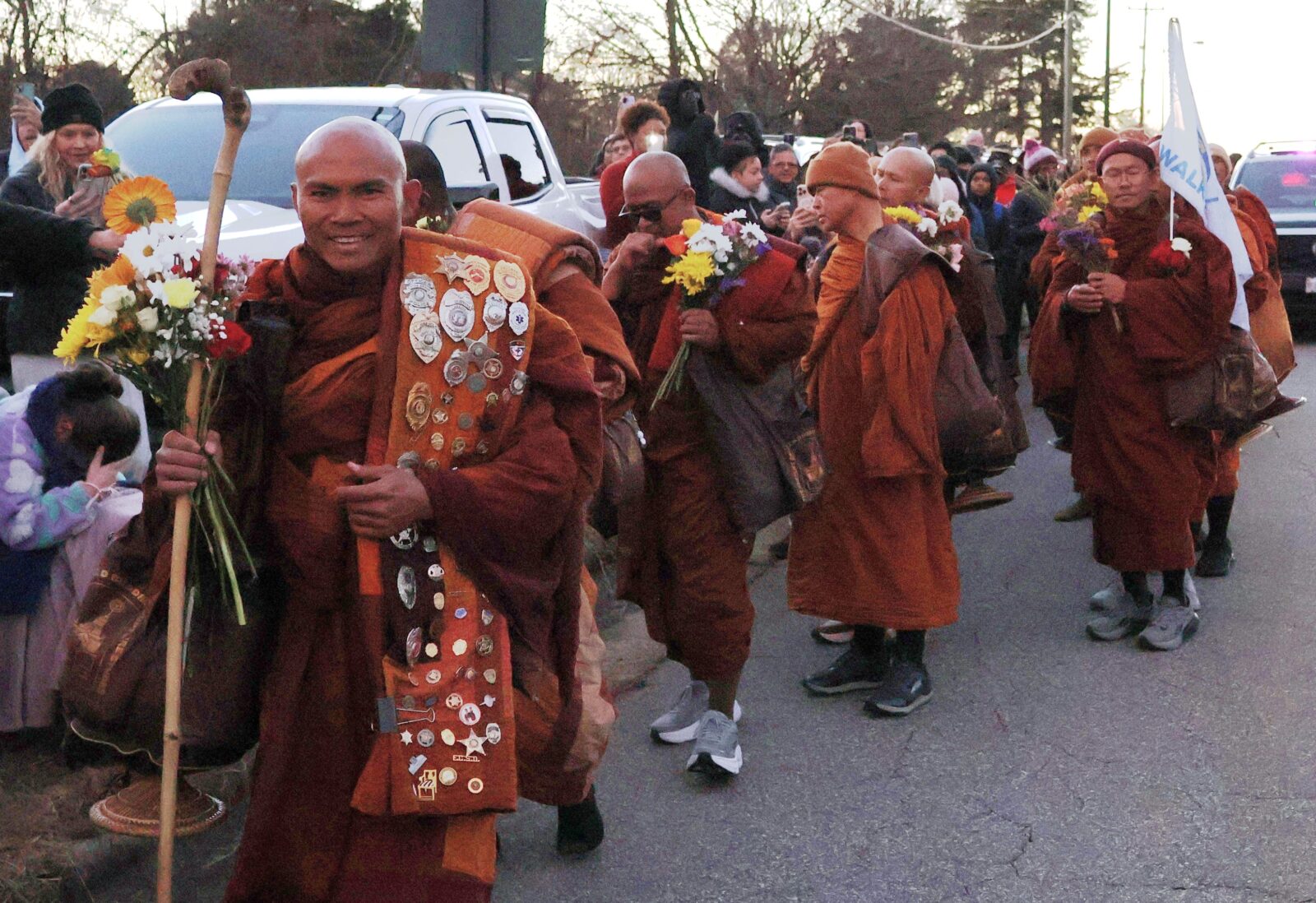
After 108 Days Walking Barefoot Across America, a Small Band of Saffron-Robed Pilgrims Has Offered the Most Radical Act of Our Time — Choosing Peace
Dzogchen Khenpo Choga Rinpoche, Khandro Padma Wongmo, and the International Dzogchen Buddha Path Sangha | February 14, 2026
WASHINGTON — On a cold Wednesday afternoon in February, as the dome of the United States Capitol gleamed in winter light behind them, nineteen Buddhist monks in saffron robes walked in single file toward the Lincoln Memorial. Behind them stretched a sea of thousands — families, retirees, children clutching handmade signs, strangers who had driven through the night from Wisconsin and Pennsylvania and North Carolina.
No one shouted slogans. No one carried political banners. The only sound was the soft padding of footsteps and, occasionally, a voice calling out from the crowd: “Thank you.” “We love you.”
At the front of the procession walked the Venerable Bhikkhu Paññākāra, barefoot despite temperatures hovering just above freezing, holding a wooden staff in one hand and a single yellow rose in the other. His robe was covered with pins — mementos from sheriffs and mayors and ordinary Americans he had met along a 2,300-mile journey that began 108 days earlier in Fort Worth, Texas.
Beside him trotted Aloka, a rescue dog from India whose name means “divine light” in Sanskrit, and who had become an unlikely symbol of the pilgrimage that has captivated millions.
When Paññākāra finally reached the steps of the Lincoln Memorial and turned to face the crowd — later estimated at more than 21,000 in person and countless more watching online from six continents — he did not speak of policy. He did not criticize any leader or condemn any nation. Instead, he offered something that felt, in the fractured landscape of 2026, almost unbearably simple.
“The Walk for Peace is not a protest,” he said, his voice carrying across the Mall in pin-drop silence. “It is not to convert. It is a reminder that hope still exists when people are willing to care. Hope is the final light that must never go out.”
A Sacred Number, An Ancient Practice
The number 108 holds profound significance across Buddhism, Hinduism, and Jainism. It represents spiritual completion, cosmic order, and the wholeness of existence. For the monks of the Hương Đạo Vipassana Bhavana Center, walking for exactly 108 days was not an arbitrary choice — it was an offering, a prayer made manifest through the simplest and most universal human action: putting one foot in front of the other.
The tradition of peace walks runs deep in Theravada Buddhism. The Buddha himself was a walker, traversing the dusty roads of ancient India to share his teachings. For his modern disciples, the practice serves as both meditation and message — a reminder that peace is not merely an idea to be debated but a path to be walked.
“When peace is cultivated within,” explained Long Si Dong, a spokesperson for the Fort Worth temple, “it naturally ripples outward into society.”
The monks practice Vipassana meditation, an ancient technique focusing on breath and the profound connection between mind and body. Some walked barefoot for much of the journey — feeling each pebble, each crack in the asphalt, each patch of ice — as a way of remaining utterly present in each moment.
This is the first teaching the walk offers to our hurried age: that peace begins with presence. In a world of infinite distractions, where our attention has become the most contested currency, these monks demonstrated something radical — the power of simply being where you are, fully and completely.
Through Fire and Ice
The pilgrimage was never meant to be easy, but no one anticipated just how demanding it would become.
In November, as the monks walked along U.S. Highway 90 near Dayton, Texas, a truck struck their escort vehicle, sending it careening into two monks on the roadside. The Venerable Maha Dam Phommasan suffered catastrophic injuries. His leg had to be amputated.
The tragedy might have ended the walk. Instead, it transformed it. As Phommasan recovered, his brothers pressed on, carrying his spirit with them. In January, still in a wheelchair, he rejoined the group in Snellville, Georgia. On the final day in Washington, he wheeled himself into American University’s arena to thunderous applause, a living testament to the principle at the heart of the Buddha’s teaching: that suffering is universal, but how we respond to suffering defines who we become.
“To see such a radical embrace of personal tragedy for the sake of a greater communal good is a profound witness,” observed one member of an interfaith dialogue group who traveled to Washington for the ceremony. “It is the Beatitudes in action.”
Winter brought its own trials. The monks trudged through ice storms in the Carolinas, walked through snow in Virginia, endured frigid mornings when even those who preferred to feel the ground beneath their feet had to don boots. Three monks, including Paññākāra himself, had walked barefoot through much of the Southern states — and continued to do so whenever conditions permitted, even as temperatures plunged.
And yet their response to hardship remained unchanging. When drivers shouted obscenities, the monks smiled and offered a blessing: “May you be well, happy, and peaceful.” When weather forced detours, they adjusted without complaint. When Aloka, the beloved peace dog, developed a chronic leg problem, a veterinarian in South Carolina offered surgery free of charge — another small miracle in a journey that seemed to multiply them.
What Leaders Saw
The Walk for Peace was never intended as a political movement. The monks made this clear at every stop: they came not to lobby or advocate, though they did submit a request to lawmakers to recognize Vesak — the Buddha’s birthday — as a national holiday. They came to offer what Long Si Dong called “a spiritual offering, an invitation to live peace through everyday actions, mindful steps, and open hearts.”
But politics came to them.
Governor Josh Stein of North Carolina became the first American governor to meet with the monks, declaring January 24, 2026, as “Walk for Peace Day.” Governor Abigail Spanberger of Virginia followed when the pilgrims entered Richmond, issuing her own proclamation. Texas had already declared “Austin Walk for Peace Day” back in November. Greensboro, North Carolina, joined the growing list of municipalities honoring the journey.
On the final day, House Democratic Leader Hakeem Jeffries and former House Speaker Nancy Pelosi greeted the monks as they passed the Peace Monument on Capitol Hill — a fitting encounter at a sculpture dedicated to reconciliation.
Even the Dalai Lama took notice. Tencho Gyatso, his niece and the president of the International Campaign for Tibet, read his message to the crowd at the Lincoln Memorial: “Their initiative illustrates how religious practitioners can contribute in a practical and constructive way to social harmony and public dialogue. May their walk help sow the seeds of greater peace, understanding, and compassion in the United States and beyond.”
These endorsements matter — not because the monks sought them, but because they reveal something important about the power of moral witness. In an era when political leaders are often trapped by partisan expectations, the monks offered something no politician could: credibility born of sacrifice. They had walked 2,300 miles. They had lost a colleague’s leg to their commitment. They had nothing to sell, nothing to gain. And in that selflessness, they created space for leaders across the political spectrum to step forward and affirm a value that should transcend ideology: the worth of peace.
The Cathedral of Many Faiths
Perhaps the most remarkable scene unfolded not at the Lincoln Memorial but a day earlier, on the steps of Washington National Cathedral.
There, surrounded by leaders from numerous faith traditions — Buddhists, Christians, Jews, Muslims, Hindus — the Venerable Paññākāra stood before thousands and said something that might reshape how we think about religious harmony:
“In front of you all, you can see all religions’ leaders here together for the same mission: peace. This is the first time to me, that we are working together. We are walking together on this path to find peace for ourselves, to share that with our nation and the world.”
Washington Episcopal Bishop Mariann Budde — who had made headlines weeks earlier for her bold sermon during the presidential inauguration — opened the gathering with the Prayer of St. Francis: “Lord, make us instruments of your peace. Where there is hatred, let us sow love.”
The symbolism was inescapable. Here was an Episcopal bishop, in the great Gothic cathedral of American Protestantism, welcoming Buddhist monks with a medieval Christian prayer while representatives of every major world faith stood shoulder to shoulder behind them. What might have felt forced or performative instead radiated authenticity — because everyone present had gathered not to defend their own tradition but to honor a shared aspiration.
When asked about religious extremism, one of the monks offered a response that deserves wide consideration: “All religions teach people how to live, how to be a better person in this society, how to support society, and how to support this country where we live. Now that we are in this church and so many faith leaders are joining us, this world should be like this. For me, it should be like this. There is no need to be separate or any division at all whatsoever.”
Unlocking the Box
The most powerful moment of Paññākāra’s teaching came in an unexpected form: a simple reframe of what peace actually is.
“We walk not to bring you any peace,” he told the cathedral crowd, his voice gentle but certain. “Peace never left us. It’s just that we cannot see it. You have locked it and put it in a box, and you have left it somewhere. You’ve forgotten it.”
This inversion carries profound implications. Peace, in this view, is not something we must create through treaties or negotiations — though those matter. It is something we must remember, rediscover, return to. It exists already, within each of us, waiting to be unlocked.
And the key? Mindfulness.
“All you need to do is just practice mindfulness to unlock that box where you have kept peace and happiness inside,” Paññākāra said. “Now it’s your job. It’s your duty, to find it and unlock it. You’re the only one who can do this, not the venerable monks, not the reverends, nor anybody else, but you.”
He offered practical advice, delivered with the dry humor that marked many of his talks: “Please don’t touch your phone when you wake up in the morning.”
The crowd laughed — but the point was serious. Our devices, our feeds, our constant consumption of news and conflict, have become barriers between us and the peace that waits within. The monks, who walked for months without the armor of distraction that most of us wear, had learned to access something we have largely forgotten how to find.
He led the thousands gathered at the cathedral in a brief practice: three deep breaths, hands over hearts, all in unison. Then he asked them to repeat a phrase he urged them to say each morning upon waking: “Today is going to be my peaceful day.”
“It might take seven days, seven months, or seven years to find inner peace,” he acknowledged. “But each and every single one of us, we have our own path. And please remember, don’t expect our path to be smooth and flat.”
The Ripple Effect
What does 108 days of walking actually accomplish? The cynics might note that wars still rage, that political divisions remain sharp, that the world’s problems cannot be solved by nineteen men in robes walking across the American South.
But this misses the point entirely.
More than 2.8 million people now follow the Walk for Peace on Facebook alone. Another 1.9 million on Instagram. The livestream of the Lincoln Memorial ceremony drew over 21,000 concurrent viewers from around the globe — with messages pouring in from Thailand, Sri Lanka, Portugal, Japan, Canada, and dozens of other nations.
Along the route, the monks distributed “peace bracelets” — simple Buddhist symbols of protection and blessing — to countless strangers. They stopped in churchyards in Alabama, town squares in Georgia, city halls in Virginia. At each stop, something shifted in the people who encountered them.
“I learned to let things go, forgive each other quickly,” said Feuy Yang, who drove sixteen hours from Green Bay, Wisconsin, to see the monks in person. “Just to teach them to have a big heart and not to be so angry.”
“It makes me feel like I’m invincible, I can do anything,” said Donna Walker of Alexandria, Virginia, who watched the procession pass through her city. “I can’t imagine being in the cold the way they have been, in the snow, and still persisting with kindness and peace and love.”
Tom Haddon, 71, who traveled from Nags Head, North Carolina, with his wife, put it simply: “We really feel we’re at a crisis point in this country right now. This was something we felt, who knows, creates some positive energy.”
These testimonies point to something the Buddha understood 2,500 years ago: that individual transformation and collective transformation are not separate. When one person chooses peace, when one person learns to respond to anger with compassion, when one person discovers the mindfulness that unlocks inner stillness — the effect radiates outward in ways that cannot be measured but can certainly be felt.
This is the meaning of “ripple effect” that the monks spoke of repeatedly. Every smile matters. Every act of forgiveness matters. Every moment of presence matters. These are not mere platitudes; they are descriptions of how change actually propagates through human communities.
Lessons for Leaders
In a time of geopolitical uncertainty — wars in multiple regions, tensions between great powers, rising nationalism and division — what can the Walk for Peace teach those who hold positions of influence?
First, that moral authority cannot be commanded. It can only be earned through sacrifice and consistency. The monks carried no weapons, held no press conferences, made no threats. They simply walked, day after day, embodying the values they wished to see in the world. And in doing so, they generated more attention and admiration than any publicity campaign could have achieved.
For politicians, business leaders, and influencers of every kind: people are hungry for authenticity. They can detect posturing instantly. But genuine commitment — demonstrated over time, through hardship — commands a respect that no amount of clever messaging can manufacture.
Second, that nonviolence is not passive. Walking 2,300 miles is an act of extraordinary determination. Continuing after a devastating accident requires more courage than most of us will ever display. Choosing to bless those who curse you demands a strength that aggression cannot match.
The monks showed that nonviolence is not the absence of action but the presence of a different kind of power — one rooted in love rather than fear, in patience rather than force. In a world that often equates strength with the capacity for violence, this alternative vision offers a challenge and an invitation.
Third, that religious harmony is possible. The gathering at Washington National Cathedral demonstrated that leaders of different faiths can stand together without compromising their traditions. What unites the great religions — the call to compassion, the recognition of human dignity, the aspiration toward transcendence — is stronger than what divides them. But this unity must be actively cultivated. It requires leaders willing to step outside their institutional comfort zones and affirm their common humanity.
Fourth, that everyday actions matter. The monks did not propose a grand theory of peace or a comprehensive policy agenda. They offered something far more accessible: wake up and say “today is going to be my peaceful day.” Don’t reach for your phone first thing. Breathe deeply. Choose kindness before choosing reaction.
These instructions are available to everyone — to the president and the parking attendant, to the CEO and the customer service representative. Peace does not require a position of power. It requires a decision.
What You Can Do
As the monks prepared to board a bus for their return to Texas, Paññākāra promised that the Walk for Peace would not end. He pledged to continue teaching, to continue spreading the message of mindfulness and compassion.
But the monks’ work is not ours to delegate. As Paññākāra emphasized repeatedly, peace is each person’s individual responsibility to unlock and nurture. Here is what their journey suggests we might do:
Begin each day with intention. Before the news, before the emails, before the rush — take three deep breaths with your hand on your heart. Declare your intention to make this a peaceful day. The monks understood that how we start determines how we continue.
Practice presence. Put down the phone during meals. Walk without earbuds sometimes. Notice the ground beneath your feet, the sky above your head, the faces of the people around you. The monks walked 2,300 miles in attention; we can walk a single block the same way.
Respond to anger with blessing. When someone cuts you off in traffic, when a colleague speaks harshly, when the news makes your blood boil — pause. Remember the monks who smiled at those who cursed them and said, “May you be well, happy, and peaceful.” We cannot control others’ behavior, but we can choose our response.
Support interfaith dialogue. Attend events that bring different religious communities together. Volunteer with organizations that build bridges across traditions. When religious division threatens, remember the image of saffron robes and black clerical collars standing side by side at the National Cathedral.
Engage with leaders constructively. Write to your elected officials not only to complain but to encourage. Thank them when they take courageous stands for peace. Remind them that their constituents are watching — and that moral leadership matters.
Make small offerings. The monks traveled with nothing, relying entirely on the generosity of strangers. That generosity — food offered, doors opened, veterinary care donated — was itself a form of peace practice. Find opportunities to give without expectation of return.
Walk. Perhaps literally. A pilgrimage need not span 2,300 miles to be meaningful. Walk to a place of significance in your community. Walk with others in solidarity. Walk alone in contemplation. The simple act of walking — mindfully, purposefully — connects us to the monks and to the Buddha and to every spiritual tradition that has recognized movement as prayer.
The Light That Must Never Go Out
On the steps of the Lincoln Memorial, with Abraham Lincoln gazing down from his marble chair — the president who held a nation together through its bloodiest trial — Paññākāra offered his final words.
“This world has been receiving so much anger and hatred and everything already,” he said. “That is why it’s coming back to us with all kinds of sufferings, all kinds of disasters. We walk not to bring any attention to us, but we just hope that we raise awareness of peace to all the people who will meet along the road.”
He paused, looking out at the diverse multitude before him — people of all races and faiths, united for one afternoon in something that felt, impossibly, like hope.
“Hope is the final light that must never go out.”
Kimberly Bassett, the Secretary of State for the District of Columbia, presented the monks with an official proclamation. But her words spoke to something larger than one city’s recognition:
“Today may mark the end of a 2,300-mile walk, but it’s not the end of our journey for peace. Your pilgrimage has brought people together across cities, states, and communities, all faiths, all backgrounds, all of us together, united in the shared belief that we can choose healing over harm, understanding over division, and peace over conflict. Your every step carried a message, and that message now lives here with all of us.”
And so the monks departed — by bus to Fort Worth, where they will walk the final six miles back to the temple where it all began. The circle will be complete.
But the ripples they set in motion continue to spread. In the hearts of the millions who followed their journey. In the minds of the leaders who met them. In the countless small decisions, made in countless ordinary moments, to choose kindness over cruelty, presence over distraction, peace over strife.
“Love and kindness does not need power, money, or a title,” Paññākāra reminded the crowd. “It is simply the choice to stop before hurting, to sharpen before speaking.”
Nineteen monks. One dog. 108 days. 2,300 miles. And a question that echoes still:
How many of us are willing to walk to bring world peace?
Perhaps the answer begins with a single step.
The Walk for Peace concluded at the Lincoln Memorial on February 11, 2026. The monks returned to the Hương Đạo Vipassana Bhavana Center in Fort Worth, Texas, on February 15, 2026. Follow their continuing work at WalkForPeace.org.
https://www.pbs.org/newshour/nation/watch-millions-inspired-by-monks-walk-for-peace
https://www.youtube.com/@walkforpeaceusa