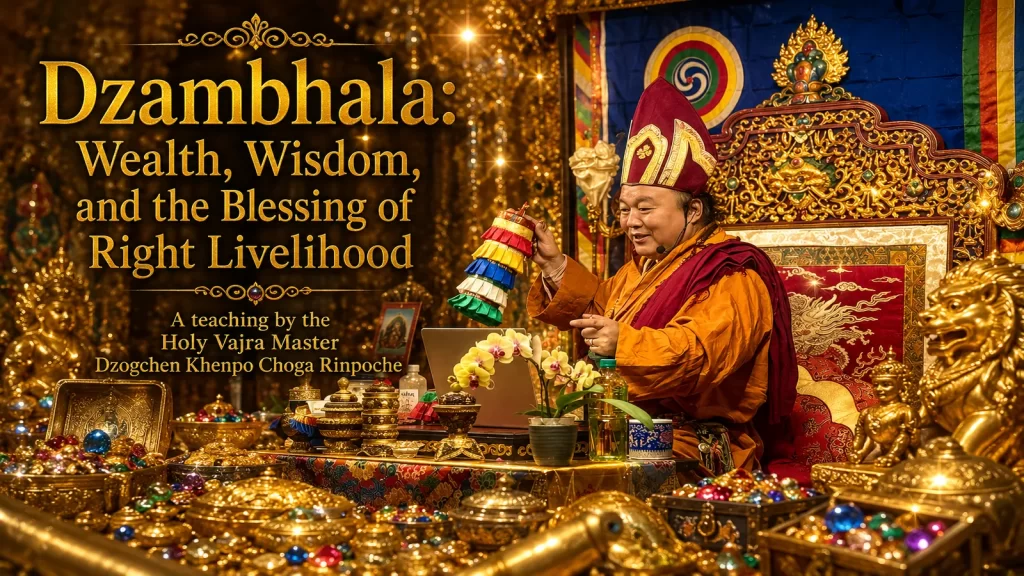
A teaching by Dzogchen Khenpo Choga Rinpoche
There is a principle at the heart of all Dharma: when cause and condition come together, a result naturally arises. This truth applies not only to liberation; it applies to every domain of life, including wealth.
Who is Dzambhala?
During the seven years that Buddha Shakyamuni first taught the Dharma, the years of the Four Noble Truths, he was supported and accompanied by a vast assembly of Dharmapalas, protector deities including Yakshas and Mamos. Among all of these Dharmapalas, one stands out as the greatest: Dzambhala.
Dzambhala is often called a wealth deity, but to understand him only as a giver of riches is to miss his true nature. He is, first and foremost, a Yaksha general, a protector of extraordinary bravery and power.
When Devadatta hurled a great rock at the Buddha intending to cause him harm, it was Dzambhala who threw himself between the rock and the Blessed One, blocking any harm from reaching him. Even as Vajrapani shattered the rock, Dzambhala stood as a living shield. This is the character of Dzambhala: fierce, courageous, and utterly devoted.
The Assembly of the Yakshas
To understand Dzambhala’s place, we must understand the hierarchy of the Yakshas. Vajrapani stands at the head of all the Dharmapalas. Under Vajrapani are twenty-eight Yakshas, and of these, eight are the most powerful. Among the eight, Vaishramana is the king. And within this royal assembly, Dzambhala holds the role of treasurer.
The name “Yaksha” itself reveals something important. “Yaksha” means “harm-giver“—not because these deities harm innocent beings, but because they have the power to subdue and overcome harmful forces. They function like a divine police force, protecting the good and overpowering those who cause suffering. This is why they appear fierce. This is why their blessing is so potent.
The Two Hands of Dzambhala
Dzambhala is recognized by two symbolic attributes, one in each hand, and together they tell the full story of his activity.
In his right hand, Dzambhala holds a victory banner. This banner represents the defeat of the maras, the forces of delusion and harm, and the victory of goodness, virtue, and awakening. Wherever Dzambhala’s influence reaches, the forces of obstruction are overcome.
In his left hand, he holds a special animal called a neulay, often called a mongoose, but it is not. It symbolizes the gathering and giving of wealth. But notice the direction of that movement: Dzambhala first takes — he gathers wealth from those who hoard it through stinginess and miserliness — and then gives generously to those who are engaged in virtuous activity. This is not passive charity. This is active, intelligent generosity. Dzambhala supports those who are doing good things.
The Right Kind of Wealth
Here is something essential that Rinpoche teaches: more wealth does not automatically mean more happiness. In fact, many people with great wealth have more worry, more suffering, and more miserable lives. This is not a contradiction. It is the law of cause and condition.
Some animals are born with beautiful skin and are killed because of it. Some people accumulate gold and come to harm because of it. Wealth without wisdom becomes a danger. This is what Dzambhala’s blessing protects against.
When we receive Dzambhala’s empowerment, we are not asking to become freeloaders. We are not saying, “Give me gold so I don’t have to work.” If you make that request, you will not receive the blessing.
The real prayer is this:
Dzambhala, give us wisdom. Give us knowledge. Give us the ability to generate good wealth, to work hard and enjoy working, to enjoy creating, to enjoy doing business. Help us transform whatever resources we have into something that benefits ourselves and others.
This is the kind of wealth that does not become a cause or condition of suffering. It is the kind of wealth that becomes a cause and condition for enlightenment.
Work Is Not a Burden. It Is a Blessing
There is a very common modern confusion: many people think of work as slavery. Something to endure. Something to escape.
But consider: having work is already a blessing. The question is not whether to work — it is how to work.
When you see the bigger picture, that your work is good for you, good for your family, good for others, good for everyone you serve — the experience of work transforms. You are no longer laboring for yourself alone. You are creating good karma through every action. You are engaged in the world as a bodhisattva in everyday clothes.
Take for example the King Ashoka or the great Dharma patron Anathapindika, who moved fully in the world of worldly activity and became enlightened through it. City people, doing city things, transforming every action into the path.
This is the interdependence we invoke when we receive Dzambhala’s blessing: doing worldly activities while becoming awakened through them.
The Nature of Blessing and Empowerment
There are three aspects of what is transmitted in a ceremony like this: blessing, empowerment, and attainment.
Blessing is difficult to translate into English, because in English the word implies only good things being given to you. In the Dharma sense, blessing is more like radiation — a transmission that transforms. Just as wearing something that carries bad energy can give you a headache, the radiant presence of an awakened being or a deity carries a transforming influence. All Buddhas are blessing us all the time. The question is whether we have the tools and openness to receive it.
Empowerment comes only from the master. It is a specific transmission that awakens capacity in the student.
Attainment—both worldly and transcendent—is what the deity itself can bestow.
Today’s ceremony, Rinpoche explained, is a blessing-style empowerment—accessible, requiring no elaborate vows, and open to all who are present and sincere.
What We Are Asking For
We are not asking for obstacles to disappear. If all challenges, difficulties, and obstacles were removed from your life, the mind would go flat. Life would become empty.
The blessing we request is different: the ability to overcome obstacles, to clear obstructions, to liberate ourselves, and to benefit others.
We ask Dzambhala not to hand us wealth, but to give us the wisdom and ability to generate it virtuously, joyfully, and skillfully. We ask to see every situation as an opportunity. We ask to enjoy the work of creating, building, giving, and serving.
If you create a beautiful statue and people see it every day and are made happy, that is good business. That is Dharma. If you create a shoddy statue for quick profit and people look at it every day with dissatisfaction, something has been lost that no amount of money can replace.
How you do what you do matters. The intention behind the action matters. And through right intention, right effort, and Dzambhala’s blessing, worldly activity and the path to awakening become one.
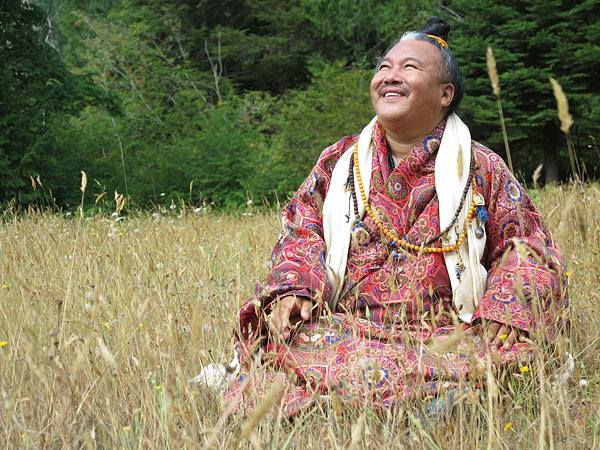
This teaching was given by Dzogchen Khenpo Choga Rinpoche, the 33rd-generation holder of the Dzogchen Longchen Nyingthig lineage. To learn more about Rinpoche’s life and qualifications, visit his full biography. To attend upcoming empowerments and teachings, see the events calendar at dzogchenkhenpochogarinpoche.org. Celebrated on the birthday of the Matsu Goddess in Taipei, Taiwan.
Frequently Asked Questions
Dzambhala is one of the most important Dharmapalas—protector deities—in the Tibetan Buddhist tradition. He is commonly called a wealth deity, but his true nature is far richer than that title suggests. Dzambhala is a Yaksha general: a fierce, courageous protector who shielded Buddha Shakyamuni from harm, who defeats the forces of obstruction, and who channels wealth from those who hoard it into the hands of those engaged in virtuous activity. He holds the role of treasurer within the assembly of the eight most powerful Yakshas, under Vajrapani’s command.
These names refer to overlapping figures across different Buddhist and Hindu traditions. Jambhala is the Sanskrit form of the same deity known in Tibetan as Dzambhala. Kubera (also called Vaishramana) is the king of the Yakshas and is closely related. Vaishramana rules the assembly, while Dzambhala serves as treasurer within it. In the Tibetan tradition, there are five forms of Dzambhala (yellow, black, white, red, and green), each with specific qualities and practices. This teaching focuses on the general principle of Dzambhala’s activity rather than on one specific form.
Not in the way people often imagine. Khenpo Choga Rinpoche is direct on this point: Dzambhala does not give wealth to those who ask to receive it without working. The blessing of Dzambhala is not a lottery ticket—it is the wisdom, energy, and capacity to generate wealth through virtuous effort. What Dzambhala gives is the ability to work hard and enjoy working, to create things of genuine value, and to see the larger purpose in what you do. The wealth that follows from that kind of effort is real, stable, and does not become a source of suffering.
A Dzambhala empowerment is a ritual ceremony in which a qualified master transmits the blessing and authorization to practice Dzambhala’s sadhana (practice). Rinpoche distinguishes three aspects of any such ceremony: blessing (a transforming transmission, like radiation from an awakened presence), empowerment (a specific authorization that can only come from a qualified master), and attainment (worldly or transcendent gifts that the deity can bestow). A blessing-style Dzambhala empowerment—as described in this teaching—is accessible to all sincere practitioners regardless of prior practice level and does not require taking elaborate vows.
Vajrapani is the head of all Dharmapalas and the supreme leader of the Yaksha assembly. Khenpo Rinpoche teaches that Vajrapani is especially powerful because he has fully conquered his own inner obstacles, and this inner victory is the source of his outer power. Vajrapani is therefore practiced first as the foundation: his sadhana clears the ground, removes obstacles, and establishes the right condition for Dzambhala’s blessing to take effect. Dzambhala’s wealth activity flows most powerfully within the field of protection that Vajrapani establishes.
Buddhism contains both renunciate and householder paths, and Khenpo Rinpoche speaks directly to the householder reality. Great Buddhist kings and lay practitioners—Ashoka, Anathapindika, King Gesar—were enormously wealthy and deeply realized. The teaching is not that wealth is wrong, but that wealth without wisdom becomes a danger. Wealth accumulated through greed, used selfishly, or clung to with attachment causes suffering. Wealth generated through skillful, joyful, virtuous effort — and used in service of self, family, and others — is a cause and condition for enlightenment. Dzambhala’s blessing is precisely this transformation: turning worldly activity into a path.
Khenpo Rinpoche’s teaching here is striking: having work is already a blessing. The mind that experiences work as slavery, as something to endure until vacation, is a mind that has not yet seen the bigger picture. When you understand that your work benefits others—that your business, your craft, and your service creates genuine value in the world—work becomes a form of Dharma practice. Every transaction done with honesty, every product made with care, and every service rendered with skill creates good karma. King Ashoka did not abandon the kingdom to become enlightened. He became enlightened through ruling it well. This is the path of the bodhisattva in the world.