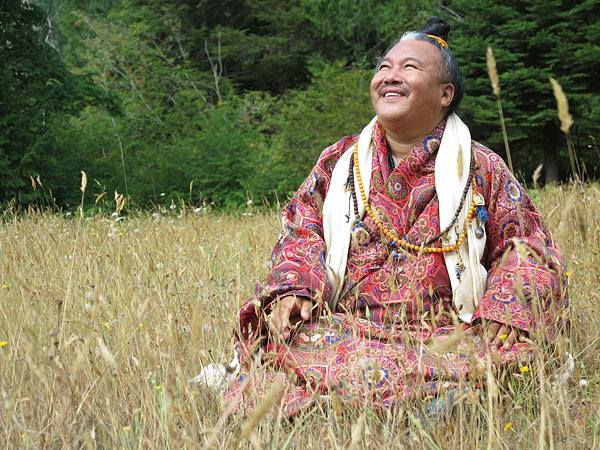
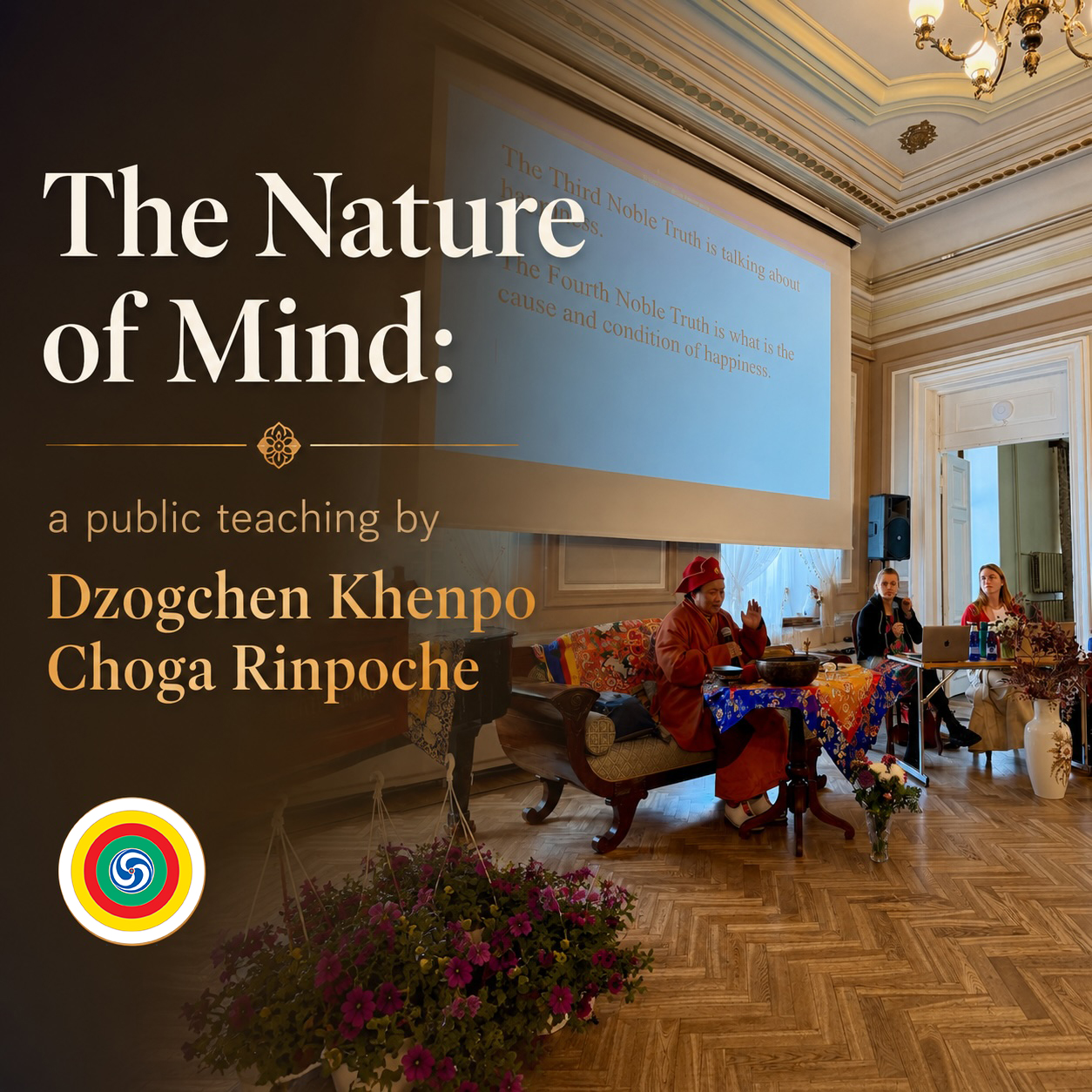
A Public Teaching by His Eminence Dzogchen Khenpo Choga Rinpoche
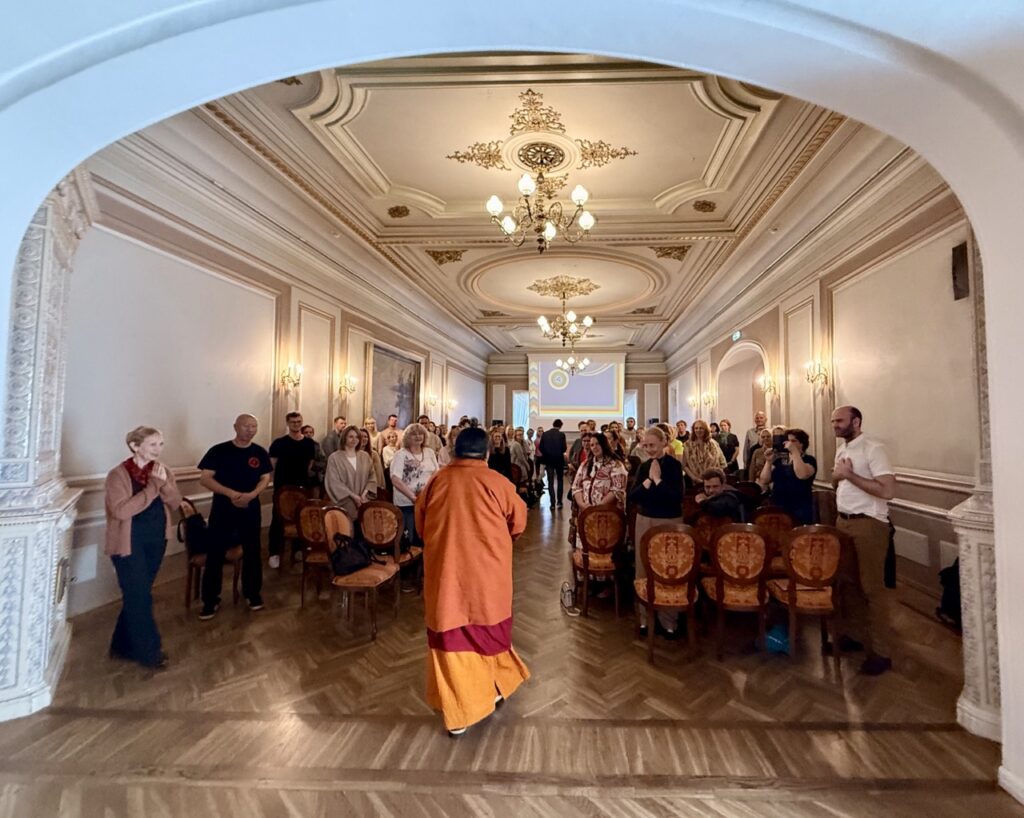
Given on Saga Dawa—the full moon anniversary of Buddha Shakyamuni’s enlightenment—in Tallinn, Estonia, on May 31, 2026
Transcribed by Bodhi Lama Wongmo
His Eminence Dzogchen Khenpo Choga Rinpoche is one of the greatest living masters of the Dzogchen tradition—an unbroken Tibetan Buddhist lineage that represents the most direct and refined science of mind ever developed. He has been transmitting these teachings continuously for decades to students across six continents. This teaching was given publicly in Tallinn, Estonia, on the auspicious day of Saga Dawa — the full moon on which, 2,952 years ago, Buddha Shakyamuni attained enlightenment. It is offered here in brief.
I. Who Is Buddha?
Today I am introducing Buddha, Dharma, and Sangha.
Buddha is very important for Buddhist people to know. Christian people know who God and Jesus. Buddhists need to know what is Buddha.
Buddha Shakyamuni wrote his own life story—it is called the Lalitavistara Sutra. Based on this and the Kalachakra Tantra, let me tell you a little about him.
Buddha was born 2,986 years ago in ancient northern India — now part of southern Nepal, a place called Lumbini. When he was born, he was extraordinarily intelligent. He studied all worldly knowledge: martial arts, science, and 64 different arts. He was a great scholar. At 21 he married. At 29 he decided to leave the palace.
His father told him not to leave. Buddha said, “If you can give me freedom beyond birth, old age, sickness, and death—the four rivers of suffering—then I will stay.” His father said that was impossible. So Buddha left, with his father’s blessing and his wife’s blessing.
From age 29 to 35, he practiced near the Naranjana River for six years. Almost no eating. Almost no drinking. Just sitting in ascetic practice.
At age 35 he attained extraordinary realizations. He subdued the four maras and attained Awakened Omniscience—he became Buddha. That was 2,952 years ago.
This was the result of three asamkhya great time cycles of lifetimes—if you write the number 3 followed by 299 zeros, that is how many lifetimes of practice produced that result.
At age 35, Buddha crossed beyond birth, old age, sickness, and death. Nirvana means crossing beyond samsara.
At that time, the land we now call India was called Mahabharata—a vast land of many kingdoms and more than 300 religions, 62 of which had sophisticated philosophical systems you could study and debate. In that environment, Buddha Shakyamuni became Buddha.
His first teaching was the Four Noble Truths, given in Varanasi. There were no Buddhists yet, no Dharma system. There were five human beings—his friends and disciples—and 80,000 local gods. Buddha taught.
He taught the Four Noble Truths for nearly seven years—almost day and night—to whoever wanted to learn. Those sutras now fill 12 volumes.
Then for 10 years he taught the 10 Paramitas: generosity, discipline, patience, diligence, meditation, knowledge, strength, skill, aspiration, and wisdom. That is the Second Dharma Wheel.
After that, for 13 years, he taught mind and Buddha: what is mind and what is Buddha.
Modern education is very good, very nice. But it does not teach mind. It teaches how to do business, how to care for the body, the house, and things—but not mind. Buddha Shakyamuni taught for 13 years what mind is. He is the scientist of mind.
Then at age 64, for 17 years, Buddha taught Tantra and Dzogchen.
At age 82, between two sala trees, Buddha Shakyamuni attained Great Rainbow Body—deathless. For ordinary beings, it appeared that Buddha died. For enlightened beings, they perceived him attain the deathless rainbow body of Padmasambhava.
Buddha taught for 47 years. His teachings fill 374 books, organized into nine yanas—a complete, systematic curriculum. Not one teaching contradicts another. They are all in alignment—one great curriculum.
Buddha believes in education. He does miracles, yes—but he really believes in education. He trained many teachers.
This world has many problems. All problems can be solved through education. Modern education is very good—but it is like one wing. It cannot fly. The second wing is Dharma. Together, it flies.
II. What Is Mind?
The most important teaching in Buddhism is mind. If you know mind, then you know all phenomena.
We try to know objects—but there are endless objects, countless objects. The more you focus on objects, the more you increase your fear. Buddhists look inward. We are called “Inner Ones” because we look to our own minds. Mind looks to mind—that is the most beautiful thing. Mind knows mind—that is Buddha.
So what is mind?
In Buddhism, we call mind
single present moment thinking only.
That is the most important term I have. Single present moment thinking only. You need to know this.
Single — each being has one mind. Not two. There is conceptual mind and nonconceptual mind. The conceptual mind of each being is only one. The nonconceptual mind is not an entity—it is the quality of conceptual mind.
Present moment — when you look back to the past, no past mind exists now. When you look to the future, future mind has not yet arisen. If mind exists, it must be in the present. Not in the past. Not in the future. That is present moment.
Thinking — this is the most important word. In English, mind is a noun. But the Sanskrit word is citta, Tibetan is sem — and what mind actually is, the most precious word, is thinking.
Most people think thinking is not that important. For Buddhists, thinking is the most important thing in the entire universe. The center of all my universe is my present moment thinking.
We cherish and try to recognize present moment thinking more than anything.
Who am I? According to Buddha’s teaching: I am single present moment thinking only.
Once you decide that—once you recognize it—you should know what time is. Buddhists do not believe in linear time. Past and present never meet. Present and future never meet. Two days do not come simultaneously. Even two nanoseconds cannot come simultaneously. Time exists as present moment only.
Here is one secret Buddhist teaching: present moment time is your mind. Time is thinking. Thinking is time. Besides thinking, there is no time.
According to perceived relative truth, there is public time. According to actual relative truth, there is no public time. Your time is your mind. My time is my mind. When your body is uncomfortable and your mind is not happy, your time is very long. When you are very happy and excited, time is very short. One hundred people in a room—one hundred different times.
Thinking has two characteristics: hope and fear. Always hoping for happiness, clinging to happiness, pursuing happiness. On the other hand, fear of suffering—not wanting suffering, refusing suffering, avoiding it.
This mind is very amazing. Always likes happiness. Does not like suffering.
What is present moment thinking made of? The five composites: form, feeling, notion, formation, and consciousness. These together make present moment thinking. There are 25 different forms, 18 different feelings, 18 different notions, 700 formations, and 8 consciousnesses—all together is one present moment thinking. One thinking has that many qualities.
III. Karma — The Power of Mind
Thinking creates karma.
Buddhist karma and Hindu karma share the same name but have different principles. Buddhist karma is created by thinking only. Only thinking can create karma. Besides thinking, nobody creates karma.
My negative thinking creates negative karma. My positive thinking creates positive karma.
What is karma? For many people, karma is a mystery. The definition is this: the power of thinking is karma. The power of mind is karma.
For example, yesterday you went to school and learned that 3+3=6. Yesterday’s thought is already gone today. It no longer exists. But the imprint of yesterday’s thought—the memory—remains in present moment thinking. That is karma.
If yesterday’s thought is gone, how can we remember? Memory itself is present moment thinking. But the object of memory is past. Very strange, yes? Memory is present moment thinking. What you remember—the object of memory—no longer exists.
We educate ourselves to become better and better by accumulating karma. Every time you repeat something, you create karma—and accumulate it. If you are repeatedly angry, you accumulate very strong karma of anger.
Your karma only exists in your mind. It never stays anywhere else. Nobody can steal your good karma. Nobody can delete your karma. Only you can delete your own good karma—and your own bad karma.
Positive thinking creates positive karma. At the same time, it deletes bad karma. Negative thinking creates negative karma and deletes past good karma. That is why we say positive karma and negative karma are inversely proportional.
If you know karma, then you have great hope.
Buddhism does not believe in an external universal creator. We believe that all phenomena—my perception, feelings, my house, everything—are created by my karma. My karma is created by my thinking only.
Therefore, if I want to change my future, I must change my mind. If I change my mind, I can change my karma. If I change my karma, I can change all my phenomena.
We don’t believe in predestination. We believe that if I want to change my future, it is in my hand — depending on how I think.
Thinking and intention are most important.
IV. The Four Noble Truths
The First Noble Truth: Suffering
We need to know samsara, and we need to know what suffering actually is.
There are three levels of suffering.
The first is the suffering of suffering — something you don’t want arrives. You don’t want to be sick, but you get sick. This we know.
The second is the suffering of change — you want to keep something, but it separates from you. That is the suffering of change.
The third is the suffering of pervasive formation — this is difficult to understand. Basically, you don’t see the problems. You don’t see the root of suffering, the causes, the conditions. You just feel flat. You don’t know.
Buddha said, recognize the problem. Buddhist philosophers like Nagarjuna and Asanga say if you recognize that something is a problem—just recognize it—then 50% of the problem is already solved. That is a very big deal.
Most of our suffering is from reactions. For example: the pandemic. The virus may be a little suffering. But the reaction was much more suffering. We scared ourselves. When we don’t understand suffering, we exaggerate it, amplify it, make it a big deal—10 times, 100 times, 1000 times more suffering.
Buddha said: we need to know suffering.
All my suffering is the result of my negative thinking and negative karma as cause. All beings’ negative thinking and negative karma is the condition. If you recognize and decide suffering is like this, you can reduce it. You can eliminate it. Suffering is in your hand.
Suffering is impermanent—that means it can change. It is not forever. Suffering is empty—it is created by your own mind, by anger, jealousy, greed, and ego-clinging. Suffering itself is empty, devoid of self. We think suffering is a permanent entity sitting there. It is not. Suffering arises interdependently. Therefore, recognizing these principles helps us.
The Second Noble Truth: The Cause of Suffering
The cause of my suffering is negative thinking and negative karma.
Most human beings point outside. They say: you are the cause of my suffering. They never say the cause is here, inside. Buddhists point inward—to negative thinking and negative karma. Especially we blame negative thinking.
Why? The more you blame your own negative thinking, the more you become liberated. Double negative is a positive. Better. If you say: my anger is so bad — you become a better person. If you say, “My anger is good, I like my anger,” then there is no reason to let go of it.
If you do this — blame your own negative thinking — you will not blame others. You will not say, “You made me suffer, you are the creator of my suffering.” Instead you think: I can change the cause. I can change my mind.
Conditions are too many to change. You cannot change winter, cold, darkness—these are conditions. But you can change your mind. Mind is cause. Everything else is condition.
My negative thinking is the cause of my suffering and the condition of others’ suffering. My positive thinking is the cause of my happiness and the condition of all beings’ happiness.
The Third Noble Truth: Cessation — True Happiness
Buddhism is the science of happiness. But we do not call it happiness—we call it cessation.
How to define happiness? For those who are sick, not being sick is happiness. For those who are poor, being rich seems like happiness. There are many levels. But having a big house does not guarantee happiness. Being famous does not guarantee happiness.
According to Buddha Shakyamuni, decreasing my negative thinking is my happiness.
The reason is this: our nature is already happy. Just decrease your negative thinking a little, and everything becomes very good. That is the Third Noble Truth.
Cessation means negative thinking and negative karma are totally finished. That is True Happiness. That is Buddha.
The Fourth Noble Truth: The Path
Our lineage worships positive thinking.
Why? Because my positive thinking is Path Buddha—Dharma for me, and Sangha for all beings.
In order to become Buddha, you must practice positive thinking. Without positive thinking, there is no Buddha. The cause of becoming Buddha is positive thinking.
What is positive thinking? Renunciation, compassion, faith, love, and wisdom.
V. On Challenges and Obstacles
Welcome obstacles. Welcome challenges.
I enjoy challenges and obstacles. Enjoy criticism. Please come.
Train yourself to overcome challenges. Every time you overcome a challenge, you become better. Every time you do not overcome a challenge, you become afraid—and that makes you very weak.
In this life there are so many challenges. I have overcome 99% of mine. In that sense I am a good teacher—because I overcome challenges.
Look at Galileo — he never gave up. Archimedes was so joyful he said, “Don’t disturb my circles!” Good people never give up good things.
Never give up good things. If you have a very good goal, never give up. Then you become very happy, joyful, honored.
VI. Questions & Answers
Q: In Western psychology, people spend time digging into past bad events. What is your opinion—should we do that, or let it be?
A: How much should you spend in the three times?
About 10% in the past. About 25% thinking about the future. Spend the rest in the present.
You need to think about the past—it is very important. Good things and bad things happened. You should not forget bad things: if you forget, you never learn from your mistakes. But you should not cling to them either. Let go, but remember, so you don’t make the same mistake. Don’t spend a long time in the past.
Right after thinking about bad things, think about good things. If you spin in one direction too long, you must spin the other direction, otherwise you get sick.
Normally, sentient beings forget good things easily and remember bad things. If someone says 100 good things and one bad word, you remember the bad word. Try to remember bad things 1% and good things 99%.
When is the right time to think about bad things? Not in the evening. Not in the morning. Around 11am, or in the afternoon, when you are bored. Not in the evening, because you need to sleep. Not in the early morning, because you need to set up your day.
Think about difficult things for a short time only. Don’t dig too long or you get stuck. It is like jumping into ice water in winter—short time, then come out. Most of the time, enjoy the hot sauna. Remember good things. We don’t forget, but we don’t sink.
Q: If achieving Buddhahood means no more suffering and no more challenges—doesn’t that make existence pointless? Isn’t it like permanent death?
A: No.
You become Buddha — you go beyond challenges. Not that challenges disappear exactly, but you are beyond them—beyond, with, and neither. Becoming Buddha means you become True Happiness. You cannot be bored. You are not stupid — you have omniscient wisdom. You are not useless — you spontaneously help each and every being in many different ways until they also become Buddha.
Buddha is not dead. Buddha is more alive than anything. Actually, sentient beings are not so alive—half dead, half alive. Enlightened beings are a little more alive. Buddha is fresh and fully awake.
Becoming Buddha is not selfish. When you become Buddha, for yourself you become Dharmakaya Buddha—absolute truth. For others, you become Nirmanakaya Buddha—an emanation Buddha in the world. Dual benefit. You become the strongest possible condition for all beings’ happiness.
More Buddhas is better. Less Buddhas is not so good.
Q: What is the difference between soul and mind?
A: Soul does not exist, so it is difficult to compare.
According to Buddhism, soul is imputed. You don’t have a soul. You have a mind. Mind never ages, never dies. You can call your mind “soul”—that is welcome. But besides mind, is there some additional thing called a soul? In Buddhism, we don’t have that.
What reincarnates? Mind reincarnates. This present moment thinking reincarnates to the next moment. And the next. And the next.
For me, Jesus Christ is a great Bodhisattva and enlightened being. I worship Jesus Christ. Soul and mind may be different things—Christianity and Buddhism are different in some places. But the sincerity of prayer—in any tradition—is very powerful. Those who pray, please don’t stop praying.
Q: (Implicit in the teaching) — How do I know who I am?
A: When your work is finished, everything is OK, and you can fully relax—ask yourself, who am I?
For most people, that question does not exist. Who cares! Like that. Most people don’t know themselves. And they don’t try to know.
In Buddhism, trying to know yourself is very good.
I am present moment thinking only.
Once you decide this—once you truly recognize it—everything changes. Your future is in your hand. Your karma is in your hand. Your happiness is in your hand.
A Note on This Teaching
This teaching was given on Saga Dawa—the full moon day commemorating the moment, 2,952 years ago, when a human being sat beside a river in ancient India, refused to accept that suffering was the permanent condition of life, and discovered something that has never been lost since.
These teachings are available to anyone who sincerely seeks them.
For inquiries: www.thebuddhapath.org
Transcribed by Bodhi Lama Wongmo, Authorized Dzogchen Buddha Path Dharma Teacher